How to choose an appointment app for your business (2026 guide)
The seven things to check before you move onto an appointment app, and the four kinds of solution on the market, each with its real price stated plainly.
Marketplace app
commission on every booking
International platform
subscription in euro, support in English
Simple digital diary
no online booking, no reminders
App built for businesses in Romania
no commission; Programări Rapide is free
The moment you start looking for an appointment app looks much the same in every trade. The phone rings exactly when your hands are full and the client in the chair is waiting. Someone did not turn up on Tuesday at 2pm and that hour can no longer be sold. The diary on the desk has three crossings-out on the same page and nobody knows any more which booking is the valid one.
The difference between a salon, a dental practice and an auto shop is not in the problem but in the details: who is allowed to see what, how long a job takes, how many people work in parallel. Which is why this guide does not compare products by name, but types of solution - four ways of solving the same problem, each with its own price, visible or hidden.
By the end you will have seven criteria you can check in one afternoon, whichever app you try.
What matters in an appointment app
1. The client books alone, with no account and nothing to install
The first test is the simplest one: open the app’s booking page on your phone, as if you were your own client. If you are asked to create an account, confirm an email or download something, every extra step cuts into the people who make it to the end. Someone who only wanted a haircut or a service slot will not sit through three registration screens. Check as well that they see only the hours that are genuinely free, not your whole schedule.
2. Notifications go out on their own, and you know on which channel
The reminder is the one feature that pays for itself: a client who gets a message the day before shows up far more often than one who gets nothing. The question to ask is which channel it goes out on - email, SMS, WhatsApp - and what it costs on top. Plenty of apps advertise “automatic notifications” on the landing page and bill every SMS separately. Get the figure before the first invoice, not after.
3. The calendar knows who is working and what is free
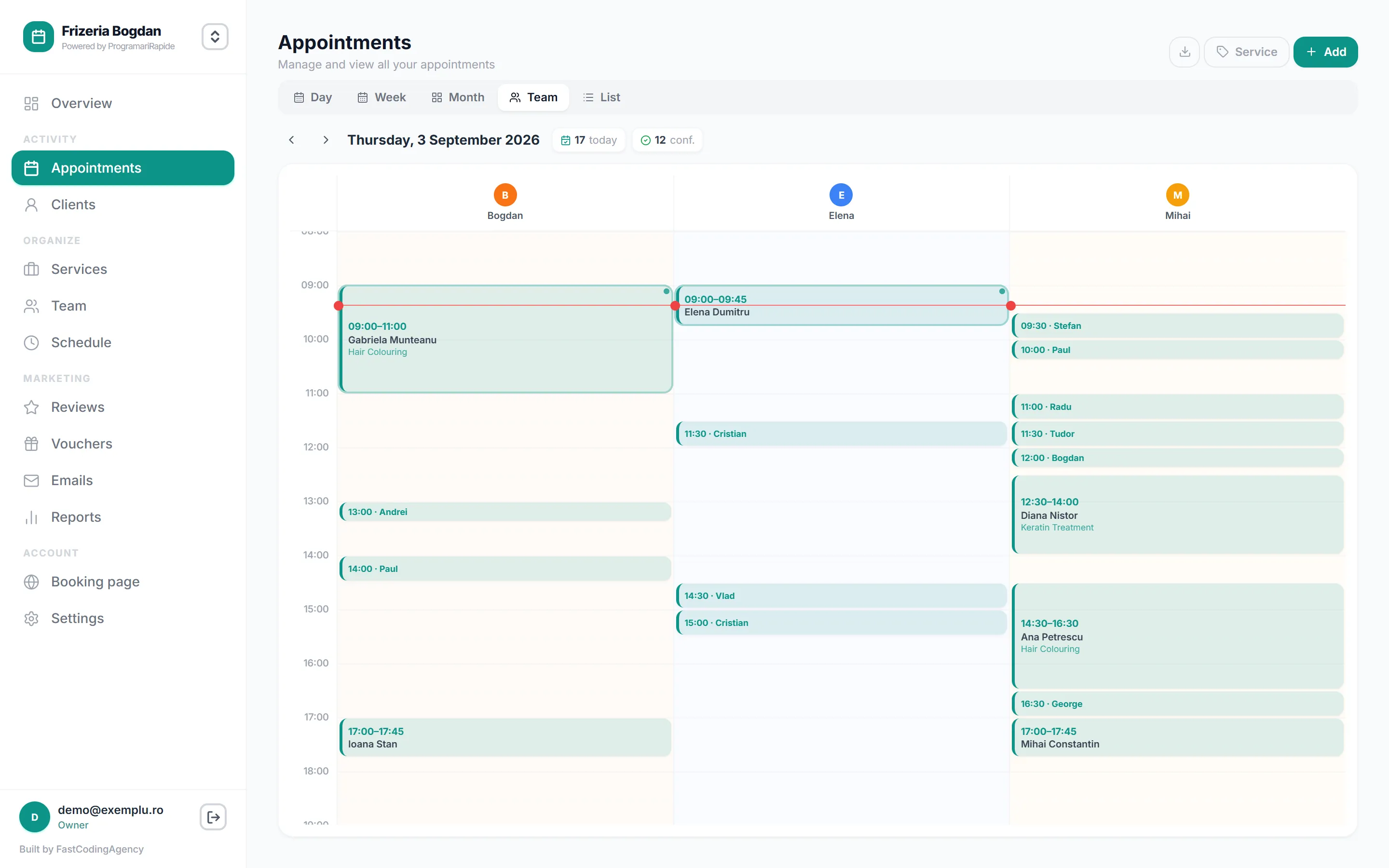
If you work alone, any calendar will do. From the moment you have a second person you need a column each, with their own hours and their own services, or you end up being the one who remembers who can do what. Separate from people there are resources: a massage room, a wash basin, a lift, a machine. If the app cannot book those separately, you will sell the same room twice and hear about it from the client.
4. Commission per booking
This is where the biggest cost difference hides. An app that keeps 5 RON from every reservation costs you 1,000 RON a month at 200 bookings, over 12,000 RON a year. A fixed subscription of 100 RON a month costs 1,200 RON a year, whatever happens, and a free app costs nothing. Commission has an unpleasant property: it grows exactly when business is going well. Do the arithmetic on your real volume, not the one from three years ago.
5. The monthly price, and what happens when you grow
Look at the next plan up, not the one you are buying now. Many apps have a cheap first tier and jump sharply when you add a fourth staff member or a second location. Ask as well what happens when you stop paying: do you keep the data, can you export it, or do you lose the client list? A free plan that never expires says something about the model; a 14-day trial that ends in a locked account says something else.
6. Support, in the language you work in
When the booking page breaks on a Saturday morning, the difference between a reply in two hours and a reply in two days shows up in the till. Check where the team is, what language it answers in and during what hours. A contact form with no promise about timing is a signal. So is a chat that answers in English, eight hours out of step, to a problem you have right now.
7. What it looks like on a phone
Most bookings arrive from a phone, and you will check your own day on a phone too, between two clients. Open both the public page and the admin panel on your screen, not the one in the sales deck. If you have to zoom to hit a button, or a table runs off the side, you will avoid the app without noticing, and you will be back on paper within three weeks.
Four types of appointment app
Almost everything you find while searching falls into one of the categories below. None of them is wrong; each is built for somebody different.
| Type of solution | How you pay | Its strength | Where it costs you |
|---|---|---|---|
| Marketplace app | commission per booking | new clients, from its own traffic | cost grows with volume; the clients belong to the platform |
| International platform | subscription in euro or dollars | many features, mature product | support out of step, in English; poor fit with the local market |
| Simple digital diary | small subscription or free | easy to start | no real online booking and no automatic reminders |
| App built for businesses in Romania | no commission; Programări Rapide is free | zero or predictable cost, support in Romanian | smaller integration catalogue than the big platforms |
Marketplace apps, with commission per booking
These are the platforms where a client searches for a service, not for a particular business. Their big advantage is real and should not be played down: they can bring you people who had never heard of you. If you are just opening and have no client list yet, the first months on a platform like that can be the cheapest advertising you will buy.
The cost turns up later, in two ways. The first is the commission, which grows along with you. The second is subtler: the client remembers the platform’s name, not yours, and next time searches there again. What you are really paying is rent on the relationship with your own client.
Worth it if you need new clients more than you need margin. Not worth it if you already have a list of people who come back - for them you are paying commission for nothing.
International platforms
These are mature products, with years of development behind them and a long list of features. If you need unusual integrations or you work across several countries, they are hard to beat.
The weak points show up after you sign. The price is in euro or dollars, so it moves with the exchange rate. Support answers in English, in another time zone’s working hours, and a problem that happens on your Saturday morning is their Friday evening. Invoicing, VAT and the way your clients expect to be contacted are all designed for a different market.
Worth it if you need something very specific that nothing local offers. For a business of one to ten people, you are generally paying for complexity you do not use.
Simple digital diaries
An online calendar where you type the bookings in yourself. They are cheap or free, take ten minutes to learn, and they do solve the crossings-out problem.
What they do not solve is the part that takes the phone out of your hand: the client cannot book alone, so you are still the one entering every hour. And no reminders go out, so no-shows stay exactly as frequent as before. You have moved the diary onto a screen and kept the work.
Worth it if you work alone, have low volume and clients who ring you anyway. Not worth it if the reason you are looking for an app is the number of calls or the hours you are losing.
Apps built for businesses in Romania
Programări Rapide is an online appointment app for any business that runs on bookings - salons and barbershops, medical and dental practices, auto shops, fitness studios, veterinary clinics and others. You pick your trade when you sign up and get a ready-made list of services to edit in a few minutes.
The model is simple: the app is entirely free, with no commission and no paid plan. It never expires, asks for no card, and includes unlimited bookings, staff and services, a public booking page, your own domain and email notifications. Client records stay yours and can be exported at any time, and the data sits on servers in Europe.
What you will not find here: the integration catalogue of an international platform and, for now, SMS notifications. Reminders go out by email, 24 hours and one hour before. We would rather tell you what the app does today.
What changes from one trade to another
Salons and barbershops. The schedule splits across people, and clients often come for one particular stylist. You need a calendar per staff member and different durations per service, because a cut and a colour do not take the same hour. That is covered at length on the page for salons.
Medical and dental practices. What matters is who sees patient data and how easily someone who cancels can be rebooked. A consultation and a treatment take very different lengths of time, and a practice with two doctors needs two calendars that never overlap on the same chair.
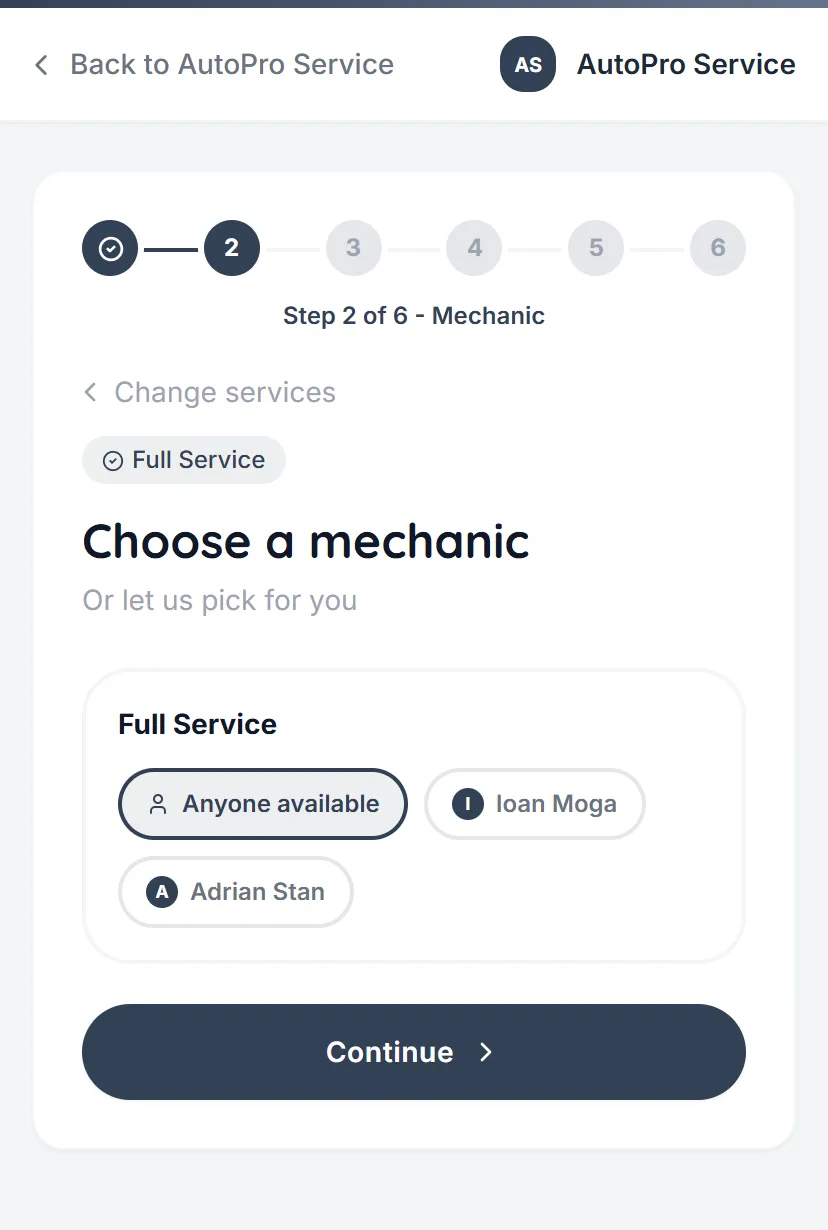
Auto shops. Here the resource is not the person but the lift or the bay. You may have three mechanics and two lifts, so the app has to book the resource separately from the person. On top of that, the calls come in exactly when someone is under a car, and a booking link takes care of most of them.
Fitness and personal training. One-to-one sessions work like any appointment, but classes have limited places and an attendance list. Check from the start whether the app does both, or only individual bookings.
How to choose, in practice, in one afternoon
Pick two apps and do the following with each, in order:
- Open the booking page on your own phone and book yourself in, as a client. Count the steps.
- See whether a confirmation went out and when the reminder goes. If it is SMS, ask what it costs.
- Add a second staff member and a resource (a room, a lift, a machine). See whether the hour is blocked correctly.
- Work out the cost over a year at your real volume, commission included.
- Write a question to support on a Saturday morning and see when they answer.
If you would rather start from the full feature list, the client bookings page goes through them one by one, and the home page shows the app across the 17 trades it covers. The test above is still the more useful one though: an hour with the app in your hand tells you more than any sales page, this one included.
And once you have chosen, the move itself is shorter than it looks: the five steps that get your bookings online fit into one afternoon.
Frequently asked questions
How much does an appointment app cost?
It depends on the model. Marketplace apps charge nothing monthly but keep a commission on every booking. Subscription apps start at zero on their free plans and reach a few hundred RON a month for large teams. Programări Rapide is entirely free, with no paid plan and no commission. Always work the cost out over a year, not over a month.
What does commission per booking mean?
It means the app keeps a percentage or a fixed sum from every reservation made through it. At 200 bookings a month and 5 RON per booking you are at 1,000 RON monthly, over 12,000 RON a year, and that number grows precisely when business is going well.
Do appointment apps send SMS messages?
Some do, some do not, and the ones that do usually bill each message separately. Ask explicitly which channel reminders go out on and what it costs on top. Our app sends email notifications for now: confirmation, reminders 24 hours and one hour before, cancellation and reschedule.
Can one app work for several different trades?
Yes, if it is built around appointments rather than around one trade. What differs between a salon, a practice and an auto shop are the durations, the resources and who sees what, not the booking logic. Check that you can set per-service durations and resources separate from staff.
Try the app, free
Entirely free, with no time limit and no card. Unlimited bookings, staff and services, a public booking page and email notifications, in any trade.